Posts

Pretty Picture Thursday

Image
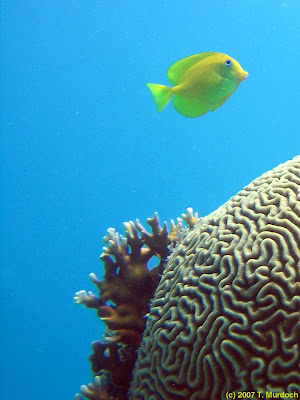
A juvenile Blue Tang poses near a Brain Coral [click photo to enlarge]

Seaweed blenny

Image
A well camouflaged seaweed blenny in a sponge.

BREAM?!? Why BREAM?

Image
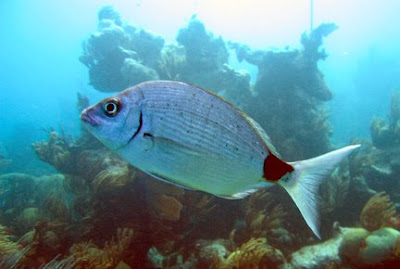
One may wonder why we would choose to name ourselves after the Bermuda Bream, considering some of the other, less pleasant names we Bermudians call the fish. Well, there was the pragmatic reason that "Bream" started with a B - so we could start our name with "Bermuda"... However, another draw was that the Bermuda Bream is actually an endemic fish, meaning it is a species found in Bermuda and no where else. Yep - our bream are ours alone, at least according to Caldwell (1965), who first stated this assertion. It' species name is Diplodus bermudensis . That said, there are sister species found across the Atlantic, including one in the Mediterranean called the White Bream ( Diplodus sargus sargus ) which looks remarkably like our guy. I took a photo of the specimen below in the Monaco Aquarium a few weeks ago. There are also bream over in the US and Caribbean, and down to South America, but with the much nicer name of Silver Porgy. Not surprisingly there is some ...
Mapping Bermuda's Coral Reefs

Image
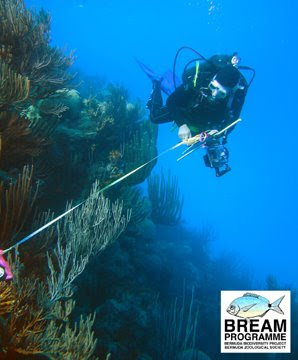
BREAM, as part of the Bermuda Biodiversity Project at BZS, has developed the most comprehensive maps of Bermuda's coral reefs and other marine habitats that exist. In this post we will describe how we mapped all of the 35,000 patch reefs in the North Lagoon of Bermuda. Our goal was to create a Geographic Information System (GIS) of all the reefs found around Bermuda. A GIS is a computerized map that also contains information about each object mapped. Computerized maps are better than paper maps because once you put all the information you know into the program, you can then ask it to tell you new information which the program can calculate based on what you told it. Some questions you can ask a computerized mapping programme are listed at the bottom of this post. Before we mapped the location of each reef into a GIS (also called a geo-referenced map database) , we needed a set of images of the entire Bermuda reef platform. The BBP, with assistance from the Dept. of Conservation ...

Wonderous Whip Morays

Image
Studying Bermuda's Own Spotted Eagle Rays A BZS-supported graduate research project undertaken in 2006, 2007 and again this summer by Matt Ajemian, a student at the U. South Alabama, Marine Science Dept , and the Dauphin Island Sea Lab's Fisheries Lab Project Context The spotted eagle ray ( Aetobatus narinari ), locally known at the “Whip Moray”, is fairly abundant over seagrass beds and sand flats of Bermuda . The Government of Bermuda has expressed interest in placing spotted eagle rays on the Protected Species List – however insufficient information of their population status and ecology has prevented any such action. The urgency for A. narinari data has become critical as they are potential predators of conch and scallops, both of which are also undergoing restoration from overharvest in Bermuda . Rapid population increases of other rays in North America ( Science journal pdf) demonstrate that rays can impact shellfisheries quickly - highlighting the need for unde...

What is Good for Grunts is Good for We Bies too!

Image
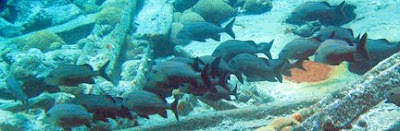
Great News! Yesterday, Elvin James, Minister of the Environment and Sport, announced the designation of a temporary No Fishing Area north of Fort St. Catherine for the 2nd year in a row. This protected area was created in order to protect a Blue-Striped Grunt spawning aggregation ( SPAG ) that has been heavily fished during previous years. Blue-striped grunts play an important role in our marine environment, as they are predators of small crustaceans and other invertebrates. Grunts often spend the day in schools on coral reefs, and then go out to neighbouring sandy areas and seagrass beds to feed at night. Studies have shown that when the grunts return to their reef home in the day time they bring important nutrients back with them that aid in coral growth. In doing so grunts act as a means for nutrients to move between the two habitats and thus act to enhance the ecological resilence of coral reef ecosystems overall. Fishing a spawning aggregation is the very definition of an un...

BREAM - What we are and what we do

Image
BREAM The Bermuda Reef Ecosystem Assessment and Mapping Programme BREAM represents the marine side of the Bermuda Biodiversity Project (BBP) at the Bermuda Zoological Society (BZS). The Bermuda Biodiveristy Project is the umbrella name for all research at the BAMZ facility, including projects conducted in conjunction with other organisations. The BBP goals are to i nitiate and coordinate a comprehensive local and international effort to catalogue all of Bermuda's flora and fauna, forming the basis for the sustainable use of the Island's living resources. The BZS was created to enhance the Bermuda Aquarium, Museum & Zoo for the benefit of Bermuda, its residents and visitors. The Bermuda Government provides continuous support of the physical plant and operational needs, while the BZS, a not-for-profit organisation, supports the development, education and research programmes at BAMZ, and organises special exhibits and activities for the community. The aims o...