Posts

Protected Marine Invertebrates, Reptiles and Mammals of Bermuda

Will add links and photos when I get a chance... Protected species The taking of any "fish" of the following types anywhere within the exclusive economic zone is prohibited— (1) Marine turtles of all species (Reptilia, Cheloniidae and Dermochelyidae) ; (2) Marine mammals of all species (Whales, Dolphins and Porpoises) ; (3) Corals of all types, (including stony corals, sea rods and seafans) ; (4) Queen conch ( Strombus gigas ); (5) Harbour conch ( Strombus costatus ); (6) Bermuda cone ( Conus bermudensis ); (7) Netted olive ( Oliva reticularis ); (8) Bermuda scallop ( Pecten ziczac ); (9) Calico scallop ( Argopecten gibbus ); (10) Atlantic Pearl Oyster ( Pinctada imbricata ); (11) Helmets and Bonnets of all species ( Mollusca Cassididae ); (12) Calico clam ( Macrocallista maculata ); (13) West indian top-shell ( Cittarium pica ), Freshwater molluscs Ancylus bermudensis Pisidium volutabundum Reptiles Bermuda Skink (Eumeces longirostris) Green Turtle (Chelonia mydas) Hawksbill ...

ICRS Plenary Talks available online

Image
The 11th International Coral Reef Symposium website has posted the Plenary Talks. See some of the best and brightest established coral reef scientists discuss the threats and ways to manage our reefs, corals and fishes. They are available at this link: here (link fixed)

Our Sargasso Sea is a "High Seas Gem"

Image
High seas gems in the spotlight 09 October 2008 | IUCN Press Release - LINK Today at the IUCN World Conservation Congress , a joint initiative has been launched to highlight special places in the least protected place on Earth: the high seas. The centerpiece of which is a brochure showcasing 10 “gems” of the high seas. Link to pdf of brochure: here The publication, launched by an unusual partnership bringing the Chantecaille Beauté company together with IUCN, World Commission on Protected Areas (WCPA), and Marine Conservation Biology Institute (MCBI), features sites such as the Ross Sea in the Southern Ocean, the Emperor Seamount Chain in the Pacific Ocean, the Sargasso Sea and Charlie-Gibbs Fracture Zone in the Atlantic Ocean, and the Saya de Malha Banks in the Indian Ocean. The 10 sites exemplify the range of habitats in the world’s oceans. “International efforts to identify and protect significant high seas places are in their infancy,”...

Photo Friday

Image
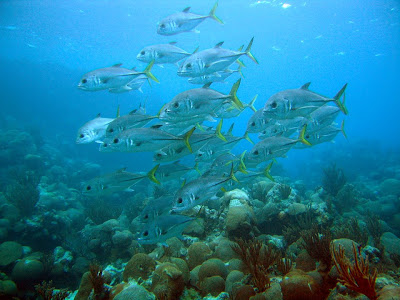
Here's a photo of a healthy coral reef off the South Shore of Bermuda. Always good too see lots of fish and lots of coral! Have a great long weekend and a Happy Hero's Holiday!

Royal Gazette Article on MPAs

Image
Scientist: Bermuda could lead the way on conservation September 30, 2008 By Amanda Dale Photo by Glenn Tucker Marine conservationist Dr. Callum Roberts,0p who advises governments around the world on the creation of Marine Protected Areas (MPAs). Bermuda could lead the way in preserving the marine life of the world's oceans, according to a UK professor. Dr. Callum Roberts, Professor of Marine Conservation at the University of York, says up to 40 percent of the Island's waters could be set aside as Marine Protected Areas (MPAs), enabling fish stocks and ecosystems to thrive. ...

BREAM Eagle Ray Researchers in the News

Image
A baby eagle ray, born during the tagging of its mother BREAM Research, funded partially by BZS, into the population structure and feeding ecology of Bermuda's own Eagle Rays (also called Whip Morays locally) continued last week. Project coordinator and PhD student Matt Ajemian, with assistance from PhD student Matt Kenworthy, and support from BREAM and the Bermuda Aquarium, Museum and Zoo, were busy collecting tracking sensor data loggers, tagging rays, collecting gut contents and listening for sonic-tagged rays around Harrington Sound and out into the lagoon and around Riddles Bay last week. A nice Bermuda Sun news article came out Friday September 27th about the project: see link here

Complicated Interactions Amongst Corals Species

Image
The above photo shows the complexity that can occur when coral cover is high and many species are in contact with each other. At least four species of coral can be seen interacting through competitive, mutualistic and neutral interactions within and between species, as well as with soft corals and a red alga.