Posts

Summer is here and BREAM is out on the water more than ever!

Image
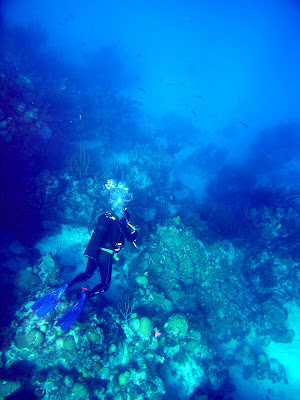
Jessie Hallett, BREAM Research Assistant, exploring patch reefs in Bermuda's North Lagoon This summer BREAM has several graduate students, funded by BZS, ACP and OTEP, taking part in a range of research projects. Matt Ajemian, from the University of South Alabama and the Dauphin Island Sea Lab , is returning for his third year of BZS-funded PhD research into the population assessment and feeding ecology of spotted eagle rays. His primary advisor is Dr. Sean Powers. Brittany Huntington is returning for her second year of ACP-funding with her PhD project which examines patch reef ecology and interactions between parrotfish and corals. Brittany goes to the Rosenstiel School of Marine and Atmospheric Science at the University of Miami, and is in Dr. Diego Lirman's lab. Katherine Yates joins us for the first time, on an OTEP-funded project to survey the forereef habitats of the Bermuda platform and develop a reliminary spatial management plan for the reefs, as part of her Masters p...
Reef related news from IUCN

Image
BREAM scientists surveying reefs for disease (c) 2007 T.Murdoch Latest News from the International Union for Conservation of Nature www.iucn.org Manage corals - Minimize climate change Protecting the oceans makes economic sense

Report on Seafan Nudibranch Outbreak 2005

Tritonia Report Thad Murdoch Population outbreak of the Tritonia hamnerorum nudibranch, an obligate grazer of Gorgonia ventalina sea fans, across Bermuda’s northern reefs in 2005 EXECUTIVE SUMMARY On July 14th 2005 a large population of the nudibranch Tritonia hamnerorum was found to be at infestation levels on a collection of patch reefs on the Devil’s Flat reef complex. This species was never before recorded in Bermuda. • The nudibranch numbered in the many hundreds on some sea fan colonies, and was feeding on the sea fans, which caused damage and death to many of these important sessile animals. • Surveys carried out over the course of the summer determined that the outbreak was patchily located over a ~20 km2 area along the Northern rim and outer patch reefs of the North Lagoon, but not observed nearer to shore, nor along the Western, Southern nor Eas...

Bermuda's Environmental Charter

Bermuda's Environmental Charter ( link pdf )

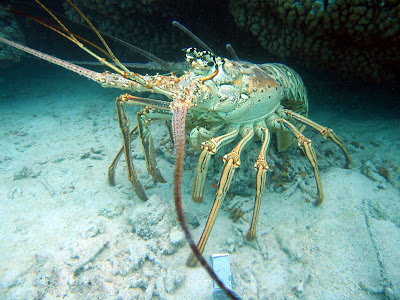
Photo Friday - Big ol' Lobster

Image
A nice big lobster we saw recently on a coral reef survey.

Bermuda Government Announcement - Closure of Blue Striped Grunt Spawning Area

Image
The Department of Environmental Protection within the Ministry of the Environment and Sports has advised the public that an area of North Shore will be closed to all fishing activities between May 1 st , 2009 and June 30 th , 2009 inclusive. The area being closed is a known “fish aggregation area” and is being closed for the conservation and protection of the Blue-striped grunt ( Haemulon sciurus ), and in accordance with the Fisheries Act 1972. The closed area being roughly rectangular in shape is enclosed by a line running in a north-easterly direction from St. Catherine’s Point, St. George’s to the Southern channel marker #12 (32 degrees 23.6 minutes North, 64 degrees 40.1 minutes West) thence by a line running along the southern boundary of the Southern channel to the Southern channel marker #16 (32 degrees 23.9 minutes North, 64 degrees 40.7 minutes West) thence by a line running in a south-westerly direction to a point 32 degrees 23.4 minutes North, 64 degrees 41.4 min...

Extreme Low Tide - updated

Image
The tops of purple sea fans ( Gorgonia ventalina ) were exposed to the air for hours yesterday during flat calm sea conditions and an extremely low spring tide. The beacon at Eastern Blue Cut is in the background. While dramatic, the surprisingly low low tide was a normal spring event. Tide predictions for Sunday show a very low tide was expected [ see link ]. Regardless, the tops of soft corals out on the reef, as well as seagrass meadows across Bermuda (see below), were exposed for hours to bright sunlight and little wind. This will probably result in some mortality and subtle ecological effects that will take some months to restore to normal. The brown substrate in the forground is a subaerially exposed seagrass meadow. This bay pictured above is normally under 3 ft of water, but was exposed during the spring tide at the end of April .